April 21, 2026
Mayhew Studio Renovation with Tree and Blue Sky
This photographic installation called Mayhew Studio Renovation with Tree and Blue Sky builds on a series of works I have made over the period of 1990 to the present called Studio Renovations .
This is the model for the final piece that will be approx. 18’W X 12’H X 4’ D. Photographic murals will be mounted on gator board attached to a wooden architectural frame/ armature.
In an effort to release archival photographs of the Mayhew Studio from their tragic implications (see essay below), I will create a sky blue space in which will sit a large tree. The tree will be built from branches and 1” X 2” lumber. Onto the branches of the constructed tree small vases will be attached into which fresh flowers and greenery will be placed. This will bring natural ‘beauty’, ‘life’, ‘light’, ‘air’ and ‘spaciousness’ to her studio. The blue sky will be created from a large piece of blue fabric draped over the left side of the installation. An electric fan installed beneath the fabric will create a billowing and moving effect.
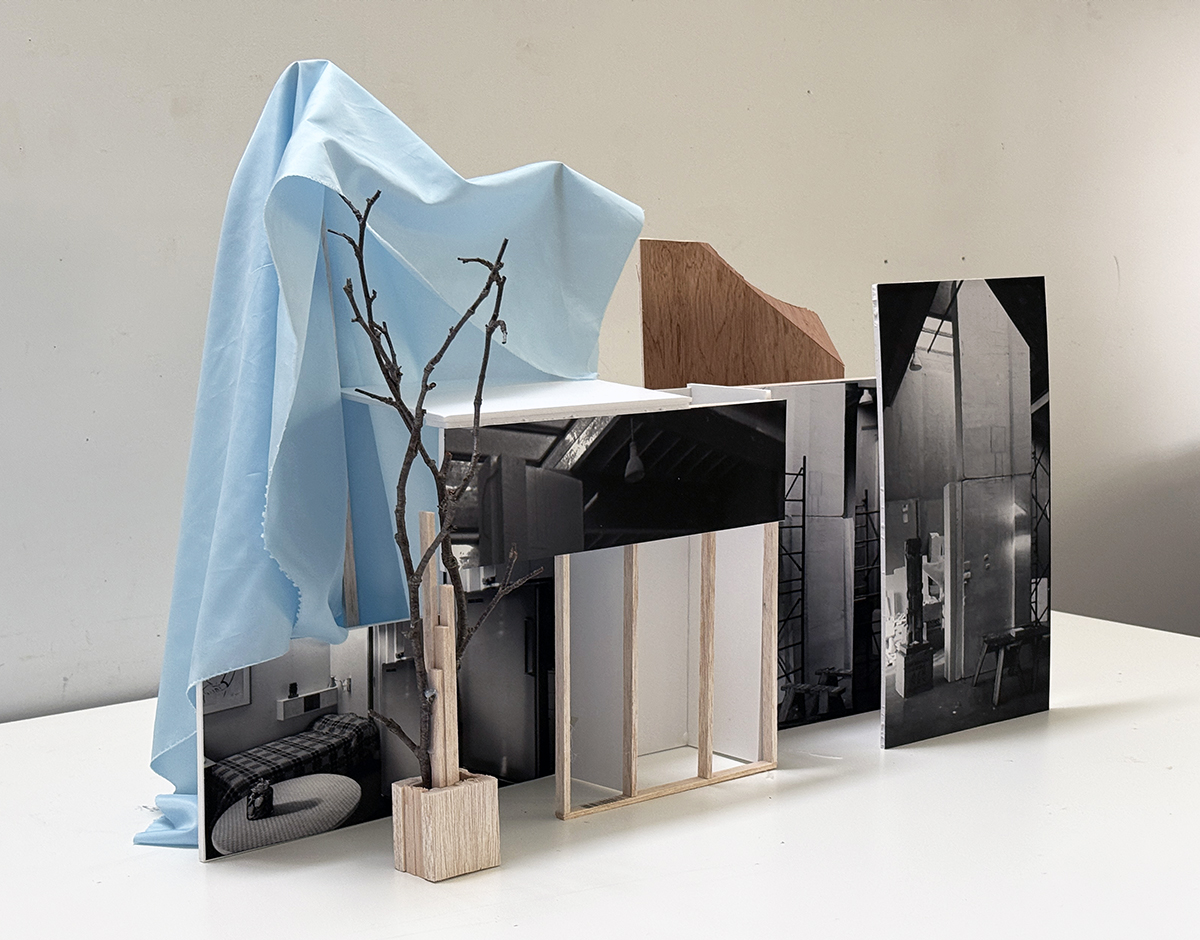
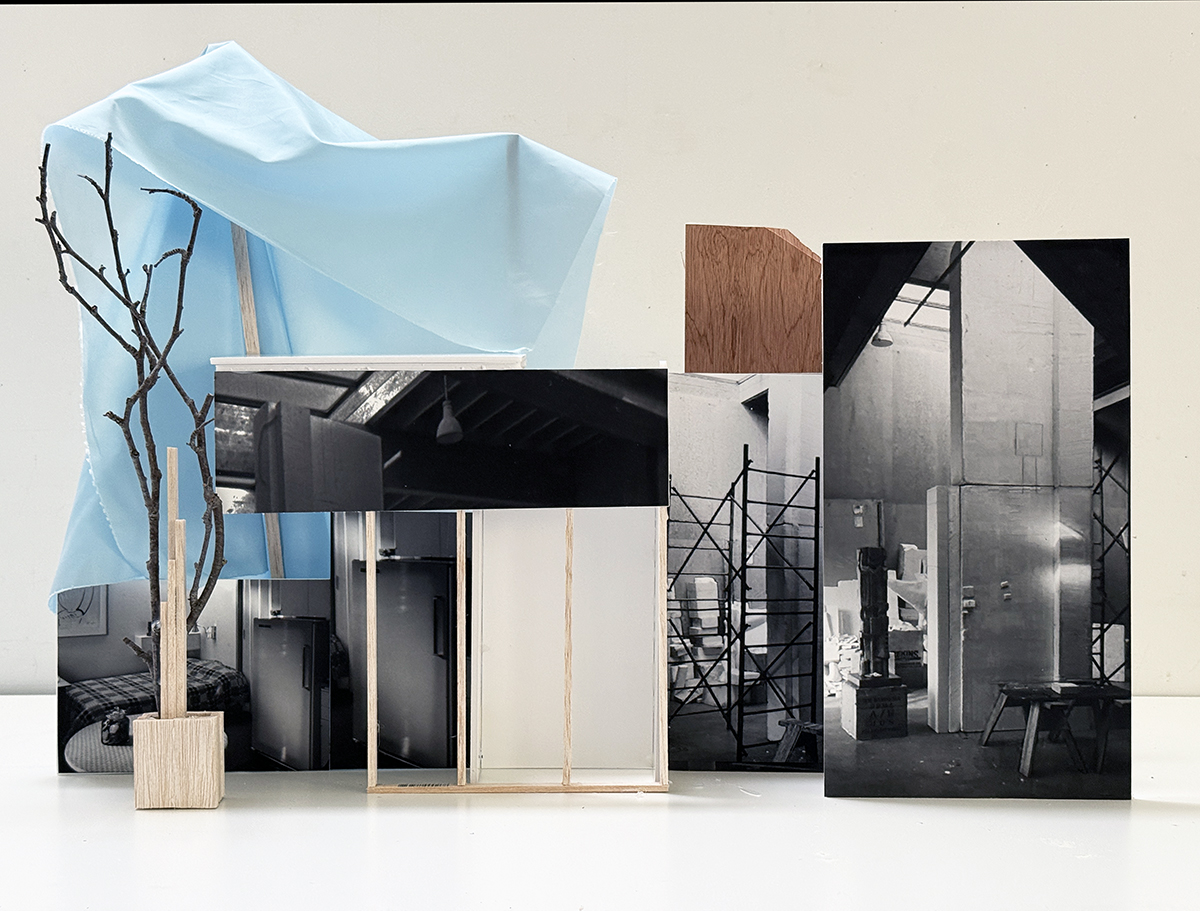
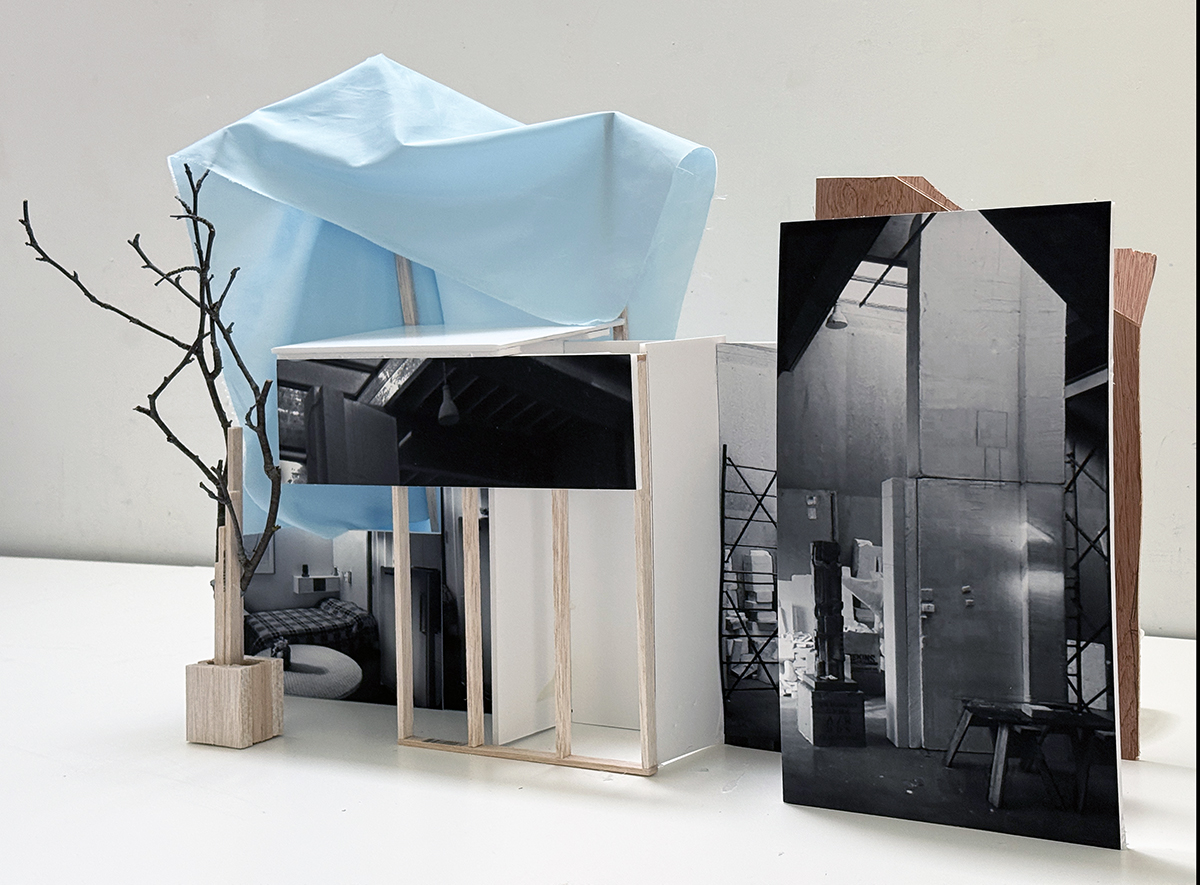
The Mayhew Studio
Elza Mayhew’s Coast Spirit has been with me since I started working at the University of Victoria in 1983. Situated in front of the McPherson Library, this monumental bronze column rises to a height of sixteen feet and sits amidst the university’s 1960’s mid-century modernist architecture. Mayhew represented Canada in the 1964 Venice Biennale, and her works are held in major collections across Canada and have been exhibited internationally.
Although her sculptural works are celebrated and impressive, it is her studio that has captured my imagination. For as long as I can remember I have wanted to step into Mayhew’s studio and understand her practice.
In the 1950s my family occasionally visited my great aunt Sylvia Sutton [1894-1980] in Victoria and as a young girl I was deeply curious. She was an artist. She lived independently in her own house and as a single woman had a lifestyle that was totally unfamiliar to me. Her house was filled with art, and she had many artist friends one of whom was Elza Mayhew who I came to understand was a very important artist.
Later, after my great aunt had passed away, I took a position in the Visual Arts Department at the University of Victoria. As an artist in my 30s I had a keen interest in art and a strong desire to have a studio of my own. I would often have a look at the Mayhew property. I knew Mayhew had passed away and I wondered who owned it. On my way to Barb’s Fish and Chips at Fisherman’s’ Wharf or walking in the area I would peer into the property. On one side a very long solid wooden fence completely blocked any view. From the roadside bushes and trees obscured the building. This modernist building revealed little of itself. From the little one could see, the building was conspicuously atypical. The waterfront property to the west was filled with high rise apartments and hotels and to the southwest was Fisherman’s Wharf, a tourist destination with boats and houseboats.
Much later, now in my ‘70s, I continued to pass by and there it was albeit even a little more overgrown and hidden from view. I came to know that Mayhew’s last years which coincided with my arrival in Victoria in the 1980s were spent in progressively declining health because of brain damage caused by the styrene toxins in the Styrofoam molds of her sculpture, a method of casting that she herself had developed. I also discovered that the Mayhew family still owned the studio and that it was rented to a local artist.
I remained interested in seeing the inside of this piece of architecture and one day a couple of years ago I had the opportunity. The artist who was renting the studio advertised an Open Studio where the public was invited to view his work. Now as I now sit at my desk, I am looking at two photographs. Each is a picture of Elza Mayhew’s studio interior.
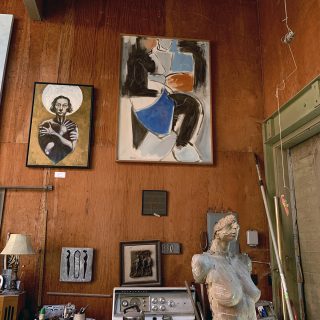 Fig. 1
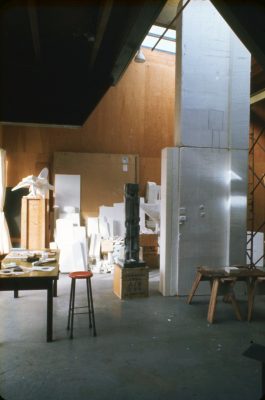 Fig. 2
One of the photographs (Fig.1) is a snapshot I took with my iPhone in 2023, the other (Fig. 2) is a 35mm slide retrieved this year from the University of Victoria archives. The slide was taken in the 1970s by Alan Hodgson, the architect who designed the studio building. The two pictures depict the same studio space but were taken more than fifty years apart. The image I took is digital, a snapshot of the studio interior during the Open House convened by the artist now renting and working in the space. The 35 mm slide of Hodgson’s was likely a documentary picture intended to feature and record his architectural design. His photographic slide captures the studio as it was when Mayhew was working in the space, likely soon after its completion.
Looking at these photographs, I sift through the near present and the past without knowing exactly what I am looking for. The protagonists of this story, both Mayhew, the artist, and Hodgson, the architect, have passed away, and I feel like I am trying to retrieve their sense of the space. I am curious about the relationship between Hodgson’s architectural space and Mayhew’s sculptural work. I wonder how the architectural space was inspired by Mayhew’s practice and how her work reflected the space in which she was building her sculptures.
I could seek out specific facts regarding the architecture, but I am not an historian, I am an artist creating a collage, attaching scraps of experience and images together to come to some understanding of the interrelationship between her work and this space.
Studio Picture Fig.1
When I look at my iPhone snapshot of the Open House in 2023 the experience of seeing the interior space for the first time comes to my mind. In addition, now that I look more closely, I see that the image captures details that I did not fully register during my very short visit. An image of that miniscule moment in time; a photograph snapped somewhat surreptitiously.
I remember finally having the opportunity to walk down the driveway and experience the exterior form of the building clad in stained cedar boards. I enter the space through the large sliding wood door. The building is an exquisite piece of northwest coast mid-twentieth century modernist architecture. Heavy timber post and beam architecture frames the large wall planes that are surfaced with 4’ x 8’ mahogany plywood. It is stained in some places by water marks. The high ceilings are punctuated by skylights and several large windows are oriented towards the garden, now overgrown. The impressive volume of space is bathed in light. I notice a hoist in the ceiling and large doors opening to the driveway and imagine heavy sculptural works entering and exiting the studio for exhibition and commission. I am here on the invitation of the artist who has rented the studio and his work is presented throughout. An example of his work is a tall female figurative sculpture. Cast in what I would describe as a classical style perhaps surrealist, the woman has a part of her head missing, maybe it did not survive the casting process or perhaps it was removed or chiseled off. A hole is cut into the figure’s stomach, and this hole in the torso holds a clock. Looking past this, I see the giant studio wall, on which are hanging several paintings and artworks by artists of Mayhew’s generation. One is signed Elza 1954 and the other is signed David. Perhaps they are portraits of Mayhew herself? An old stove is pushed up against the studio wall and on it sits a kettle and a spatula. Next to this sits a table with an array of art and sculptural tools and supplies. A small desk lamp, a vegetable grater, several ladders, a basket, what looks to be a child’s drawing of a mermaid, a shelf with small sculptural works including that of a beaver and another child’s drawing with a photograph of Elza attached to it. A photograph of one of Elza’s pieces, I believe it to be Spirit III, is pinned to the wall and several of her bronze works sit under tables. A British Columbia car license plate dated 1973 leans against a shelf. Sheafs of old drawings are piled in one corner. In and amongst all of this the artist who is renting the space is working and showing his work. I leave feeling somewhat elated to have finally had the opportunity to see the space yet somewhat disoriented knowing that there is an archive buried here.
Studio Picture Fig. 2
After being in the space, I became even more curious as to what it looked like during Mayhew’s time and sought out documentation from the University of Victoria Archives and Special Collections. Although there were no photographs easily accessible under a Mayhew search, Alan Hodgson’s archive revealed a 35 mm slide depicting the studio interior soon after it was built and I can see Mayhew’s sculptural works in progress.
Again, I see the voluminous space, the elevated ceilings and the massive plywood studio wall. I am immediately struck by the light. Light flowing from the skylight and light entering the space through the windows to the west.
Against this backdrop and most prominent in the space is a towering sculptural work in progress. Reaching the height of the ceiling, maybe twenty feet, it fully commands the space. Mayhew’s studio practice involved the creation of the sculptural form using Styrofoam which was relatively light in weight and could easily be cut and carved into. Later she would use this Styrofoam form to create the mold. At the foundry, molten bronze would be poured into the mold replacing the Styrofoam with precision; a highly dramatic and dynamic process to say the least.
I am struck by the correspondence between the sculpture and the architectural space. Both are modernist in aesthetic and complement one another. The building and the sculptures are of similar scale, and the angles of the sculpture speak to the design of the architecture. The materials Mayhew is using; the large slabs of Styrofoam (a building construction material) and solid chunks of bronze speak to a ‘truth to materials’ (a foundational modernist tenet) as evidenced in Hodgson’s use of large wooden post and beams and 4’ X 8’ sheets of untreated plywood on the walls.
In the photograph I can make out markings on the surface of the Styrofoam block, likely parts that Elza was planning to cut out. I can imagine her studio practice of cutting into and then standing back and contemplating her next cuts as the piece would progress. Perhaps she would reflect on the angled light falling across the work in progress, move through the studio space or look out of the window to take in the oceon and garden views. This photograph reveals a lively studio practice. I catch a glimpse of scaffolding armature in the background, no doubt necessary in the building of a piece of this height and size. I imagine a studio assistant or two on the scaffolding lifting and anchoring the Styrofoam pieces into place.
A pair of sawhorses in the foreground were, no doubt, used for the sawing and shaping of the Styrofoam and in the background are piles of discarded offcuts in various sizes. A table near the window appears to have drawings, sketches and notes. The stool suggests a place to sit, draw and contemplate while observing the natural world out of the window.
A cardboard crate that carries the logo Bekins Moving and Storage along with a number of wooden crates here and there remind me that these works moved in and out of the studio between foundries and exhibition spaces. A smaller finished bronze sculpture sits on a crate giving the impression it was recently uncrated after arriving home from exhibition.
The studio is a piece of sculpture in itself and the sculptures are architectural in terms of their form and content.
Archived facts and information often in the form of photographs do not necessarily reveal ‘truths’ and cannot capture the whole picture. Looking into the image I can surmise and deduce the activities that were going on and imagine what it might have been like in the 1/60th of a second perhaps even as little as 1/100th of a second this picture was taken. I think of Hodgson arriving at the studio to take the picture. His camera is loaded with colour slide film. It is a good day for the analogue camera as the light is pouring in through the windows and skylight. Hodgson fits his 35mm camera on to the tripod. Mayhew who has been working on a large piece of sculpture steps to the side so as not to interfere with the architecture which is Hodgson’s subject. This is not a portrait of Mayhew; it is a portrait of the Hodgson’s architecture. The photograph reveals while at the same time conceals.
Historical photographs can bring with them a sense of loss. We look at the happy child but know that child was later as an adult killed in a car accident. Looking at them smiling from the photograph we are so struck by the fact that they had no idea at this time what their future would hold.
Looking at Mayhew’s studio pictures I have this same feeling. At the time these photographs were taken she was a deeply engrossed in her practice. However, the Styrofoam when taken to the foundry and burned out of the mold emitted toxic fumes and these very works depicted in the photographs eventually destroyed her.
In my own art practice, I am drawn to irretrievable and forgotten histories, and I often use photography and photographic installations to explore spaces with stories that have escaped traditional archives.
I am enlarging, to real scale, several of the archival photographs Hodgson took of the Mayhew studio space. Bridging the gap between the photographic image and the physical architectural space it occupies, printed mural size photographs will be mounted on wooden frames. When installed these Mayhew ‘studio walls’, will become a second layer, a palimpsest, creating an intersection of physical architectural space and photographic space.
Taking the photograph out of the archive releases it from the confines and the power of factual history. Enlarging and moving the images into the framework of contemporary art allows them to come alive again and breathe. A conflict exists between the architectural photograph as an evidential document (a truthful, objective record) and that of an installation or staged tableaux (an imaginative space). Photography’s perceived role as a document of reality will now become a picture and it’s constructed reality will allow for a more generative space of speculation. New thoughts and ways of thinking can come to bear as these enlarged and re-contextualized photographs permeate the present.
Lynda Gammon